The Foundation of Heavy-Duty Rotary Tables: Material Selection and Quality Assurance for Large-Scale Engineering
Jul 08,2026
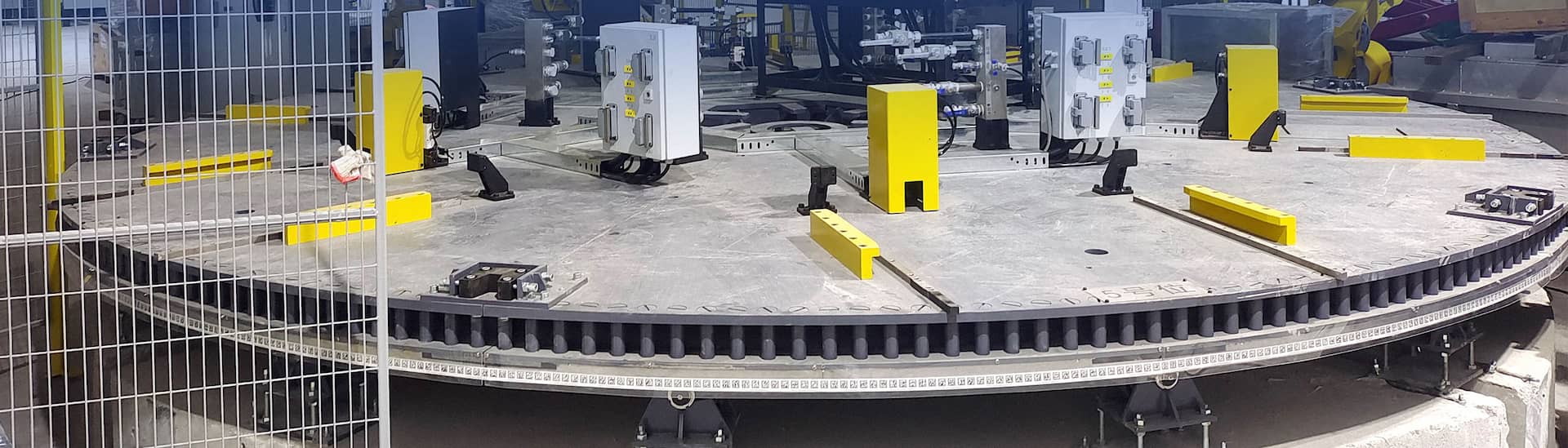
In the realm of heavy industrial manufacturing, when a rotary table exceeds a diameter of 10 meters and bears loads reaching hundreds of tons, structural integrity depends entirely on material science. To withstand extreme stresses under high tonnages and heavy point loads, Weizhong delivers unberable reliability through meticulous material optimization and advanced processing technology.
1. Four Critical Material Demands Under Extreme Conditions
For ultra-large, heavy-duty rotary tables, materials are not just the structural load-bearers—they are the ultimate line of defense for operational safety:
Extreme Rigidity & Strength: Massive structural components like the base utilize high-strength, low-alloy steel (such as Q345D/E) with a yield strength $\ge 345\text{ MPa}$. For ultra-large series up to 24 meters, plate thickness is scientifically increased to eliminate any risk of structural deformation.
Exceptional Impact Toughness: To cope with dynamic impact loads, materials must feature outstanding low-temperature impact toughness (KV value $\ge 27\text{ J}$), preventing micro-crack propagation in weld seams and stress-concentration zones.
Wear & Fatigue Resistance: Drive gears and sliding surfaces endure long-term cyclic stress. Driving elements are hardened to HRC 58-62, while sliding interfaces are reinforced with polymer wear-resistant bushings to minimize the friction rate.
Excellent Processability & Weldability: Given the massive size of the components, the materials must exhibit low weld crack sensitivity and superb machinability to guarantee high efficiency and precision during CNC machining.
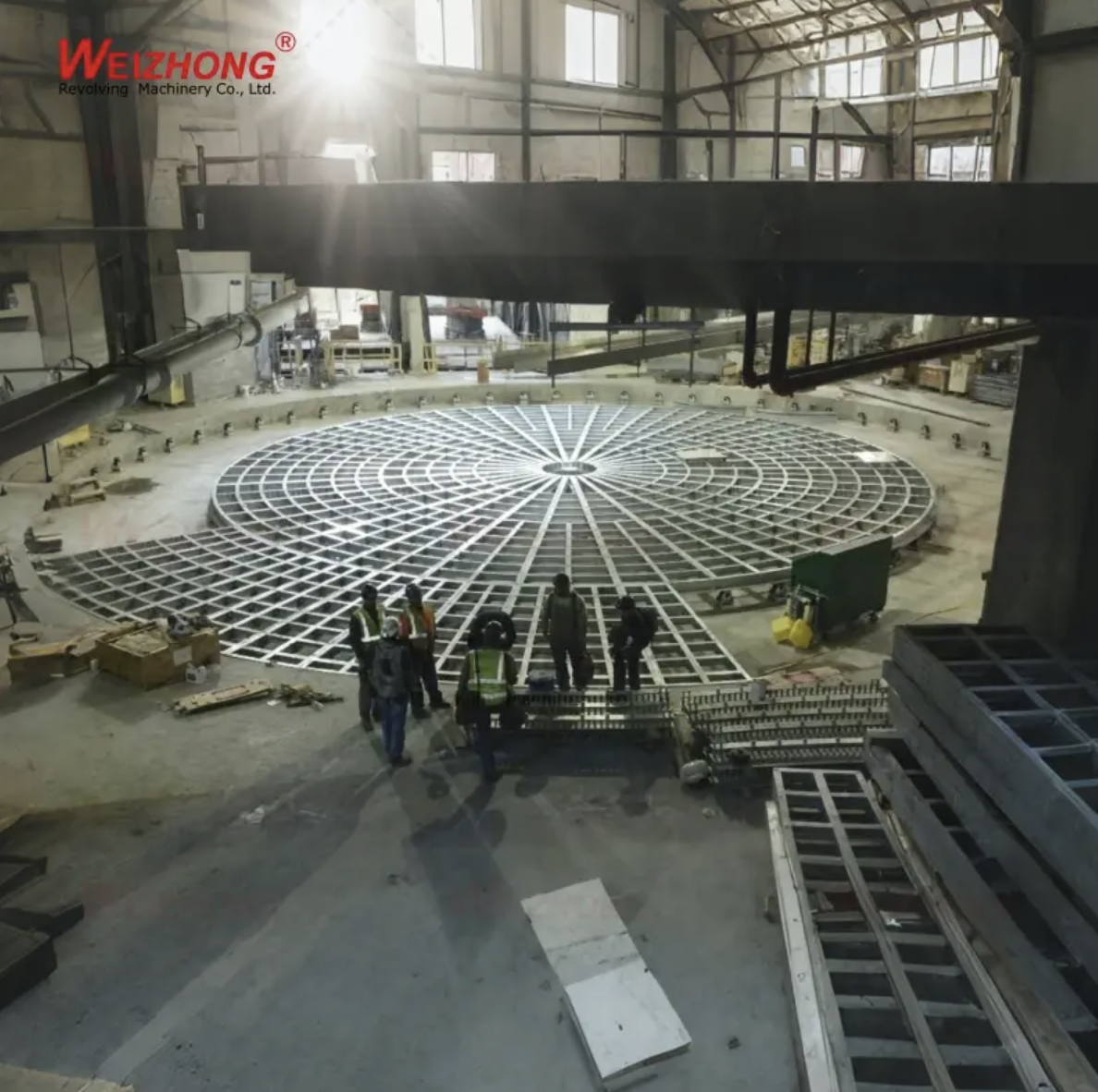
2. Tailored Material Selection for Key Components
Base & Center Column:
10–12m Series: Utilizes a fully welded integrated structure made of normalized Q345D/E steel plates.
18–24m Series: To overcome welding stress and deformation, a modular segmented assembly with reinforced rib structures is utilized, integrating cast/forged components at critical stress points.
Gear Rings & Racks: Made of carburized and quenched steels like 20CrMnTi, which feature low carbon equivalent and excellent weldability. After segmented precision casting and welding, tooth surfaces undergo carburizing, quenching, and precision grinding for flawless meshing.
Spindle & Bearing System: Spindles are forged and rolled from 42CrMo or GCr15 bearing steel, achieving an optimal balance between surface hardness and core toughness via quenching and tempering. Bearing housings use QT450-10 nodular cast iron or cast steel to achieve both superior vibration dampening and high load capacity.
Sliding Surfaces & Seals: Polymer polyamide or polyurethane sliders are installed inside the guide rails to prevent metal-to-metal dry friction. Seals are upgraded to fluororubber or polyurethane for oil, wear, and low-temperature resistance.
3. Thermal Processing and End-to-End Quality Control
The full potential of these materials is unlocked through precise heat treatment. We employ normalizing to refine grains, apply a 0.8–1.2mm carburization depth to gear rings, and perform stress-relief annealing prior to final CNC machining. This ensures that the overall assembly accuracy strictly meets the 0.2mm standard.
From raw material chemical and metallographic testing, to real-time weld temperature monitoring, non-destructive testing (ultrasonic and magnetic particle inspection), and final CNC dimensional verification—Weizhong's closed-loop quality control guarantees that every heavy-duty rotary table (ranging from 10–24m in diameter and 10–120 tons in capacity) operates with absolute stability under the harshest working conditions.